China Best 35kV Power Transformer Supplier
Choosing China’s best 35kV Power Transformer supplier requires more than comparing prices or catalog photographs. A dependable supplier should understand regional grid conditions, load profiles, climate, installation access, and maintenance practices. These details influence transformer capacity, cooling design, insulation levels, and tap changer selection. Experience matters most when specifications meet real operating conditions.
A professional manufacturer should provide clear technical drawings, material records, routine test reports, and traceable quality documentation. Factory checks may include winding resistance, voltage ratio, insulation performance, load loss, no-load loss, and partial discharge testing. Engineers should also review oil preservation, bushing design, temperature indicators, and short-circuit strength. Small omissions can become expensive problems after energization.
Field experience helps identify practical risks. A transformer may pass factory testing yet face dust, humidity, transport vibration, or uneven site foundations. No supplier is perfect for every project. Published performance data may not fully reflect local conditions. That limitation deserves honest review. Reliable suppliers explain their assumptions and respond with measurable evidence, not broad promises. They support installation guidance, commissioning records, spare parts, and after-sales communication. The right 35kV Power Transformer is therefore selected through verified engineering judgment, documented testing, and realistic lifecycle planning. Look beyond the label “best.” Examine what the supplier can prove.
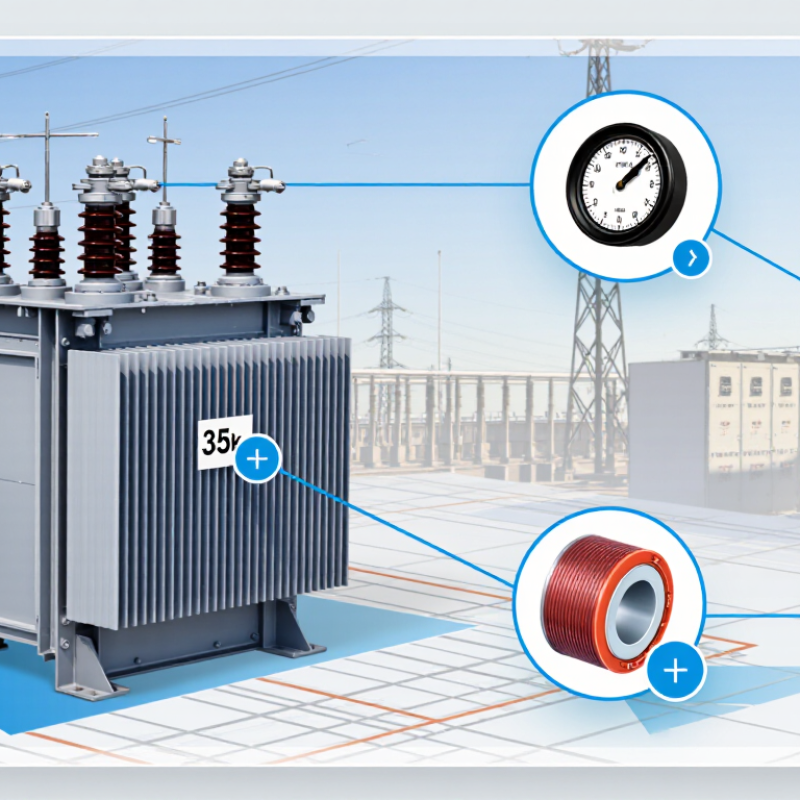
35kV Power Transformers: Definition and Core Functions
A 35kV power transformer is a medium-voltage electrical device designed to transfer energy between circuits. It changes voltage levels while maintaining the same frequency. In many distribution systems, 35kV lines connect substations with industrial sites, renewable projects, and regional networks. Classification can differ by country, so engineers must verify local grid standards.
Its core function is voltage conversion. A step-down transformer may reduce 35kV supply for safer factory distribution. A step-up design can raise generator voltage before transmission. The magnetic core and copper windings transfer power through electromagnetic induction. Insulation, cooling, bushings, and tap changers support safe operation. IEC 60076 defines key transformer requirements, including testing and performance evaluation. The IEA Electricity 2024 report expects global electricity demand to grow by about 4% annually through 2026. More demand means stronger and more flexible transformer networks. IRENA reported 585GW of new renewable capacity in 2024, creating additional connection needs.
Tips: Check load growth, short-circuit levels, cooling conditions, and altitude before selection. A practical site review matters. Protection relays, oil temperature sensors, and surge arresters should match the installation. Maintenance records can reveal overheating, moisture, or abnormal noise early. Yet no specification is perfect. Forecasts can be wrong, and oversized equipment may increase cost and losses. Engineers should compare measured data with design assumptions before approving a 35kV unit.
Key Specifications of a 35kV Power Transformer
China Best 35kV Power Transformer Supplier
Key specifications determine whether a 35kV power transformer survives daily loading, faults, and harsh outdoor conditions. Confirm the rated capacity in MVA, primary and secondary voltages, frequency, vector group, and impedance percentage. A 35kV-class unit may require a 40.5kV highest-voltage rating, depending on the utility system. Insulation levels must match local lightning and switching conditions under IEC 60076-3. Do not copy another project’s values. Small details matter.
Cooling method, temperature rise, tap range, and loss data deserve equal attention. ONAN cooling suits many installations, while ONAF can support higher continuous capacity. The specification should state no-load loss, load loss, sound level, oil volume, and short-circuit withstand capability. An on-load tap changer can stabilize voltage, but it adds maintenance points. Keep it practical. CIGRE transformer reliability surveys repeatedly identify bushings, tap changers, and accessories as important failure contributors. The IEA Electricity 2024 report forecasts global electricity demand growth of about 3.4% annually from 2024 to 2026. That pressure makes efficiency and monitoring more valuable. However, a low-loss design is not automatically the best design. Site temperature, harmonics, ventilation, and maintenance quality can change real performance. A supplier should provide routine test reports, type-test evidence, material traceability, and clear warranty terms. Field reality is less tidy. Review every assumption before approval.
Manufacturing Standards and Quality Control in China
China Best 35kV Power Transformer Supplier: Manufacturing Standards and Quality Control in China
A reliable 35kV power transformer begins with controlled materials, not attractive brochures. Chinese manufacturers commonly follow GB/T 1094 requirements, aligned closely with IEC 60076. Core steel, copper conductors, insulation paper, and transformer oil need batch-level traceability. The IEA Electricity 2024 report recorded 2.2% global electricity demand growth in 2023 and expected about 4% growth in 2024. This pressure makes stable transformer production increasingly important.
Factory quality control should include dimensional checks, winding resistance tests, ratio tests, insulation resistance tests, and no-load and load-loss measurements. Routine dielectric tests are essential. For higher confidence, buyers can request temperature-rise, lightning impulse, and partial-discharge test records. Technicians should inspect oil moisture, vacuum drying time, sealing surfaces, and bushing installation. Small details matter. A loose connection can create abnormal heating after energization. A perfect-looking report can still hide a weak process, so independent witness testing remains valuable.
Tips: Ask for GB/T and IEC test references, serial-number traceability, calibration certificates, and recent third-party inspection records. Compare measured losses with the guaranteed values. Review factory photographs carefully; clean floors do not prove process control. The strongest supplier is not simply the cheapest or largest. It is the one that explains deviations honestly and corrects them with documented actions.
How to Evaluate a China-Based 35kV Transformer Supplier
China Best 35kV Power Transformer Supplier
How to Evaluate a China-Based 35kV Transformer Supplier
Choosing a China-based 35kV transformer supplier requires more than comparing prices. Check whether the factory has qualified engineers, documented production procedures, and experience with your grid conditions. Ask for recent test records, not only attractive brochures. Routine tests should cover winding resistance, insulation resistance, ratio accuracy, and partial discharge where applicable. Type-test evidence should match the proposed design.
Visit the manufacturing site if possible. Look at copper conductors, insulation storage, drying equipment, oil processing, and final assembly areas. Traceable material records matter. So does calibration. A supplier should explain its quality controls clearly. Vague answers are warning signs. Very low prices deserve careful review.
I have found that technical communication often reveals more than a sales presentation. Give the supplier your load profile, altitude, ambient temperature, short-circuit level, and installation environment. Check how carefully they respond. Confirm delivery schedules, spare parts, installation guidance, and warranty procedures in writing. Request references from projects with similar voltage and capacity. One weakness remains easy to miss: a factory may pass tests but provide slow after-sales support. I once focused too heavily on factory equipment and overlooked response time. That mistake changed my evaluation checklist. Reliability is built through evidence, communication, and repeatable work.
Applications, Installation, and Maintenance Requirements
China Best 35kV Power Transformer Supplier: Applications, Installation, and Maintenance Requirements
A 35kV power transformer supports industrial plants, renewable-energy sites, mines, and regional substations. It commonly connects medium-voltage feeders with higher-voltage transmission networks. The International Energy Agency’s Electricity 2024 report expects global electricity demand to grow by about 4% annually through 2026. This growth increases pressure on transformer capacity and grid reliability.
Installation requires more than placing the unit on a concrete foundation. Engineers should verify rated voltage, vector group, impedance, cooling method, and short-circuit withstand capability. IEC 60076 provides the main transformer testing framework. Before energizing, technicians should check insulation resistance, winding resistance, oil level, earthing continuity, and protection settings. Keep cable terminations dry. Small moisture problems can become expensive failures.
Maintenance should follow operating conditions, not only a calendar. Inspect oil temperature, load current, bushings, gaskets, and unusual noise during routine visits. Oil sampling can identify moisture, oxidation, and dissolved gases before serious damage develops. The U.S. Department of Energy’s 2024 analysis estimates that distribution transformers consume roughly 61 billion kilowatt-hours annually in the United States. Better efficiency matters. However, maintenance records are sometimes incomplete, and that weakens decisions. A practical supplier should provide test reports, drawings, spare-part guidance, and clear commissioning support. Field experience still matters. A checklist alone cannot detect every developing problem.
35 kV Power Transformer: Applications, Installation, and Maintenance Requirements
A 35 kV power transformer is commonly used in utility distribution networks, industrial substations, renewable-energy collection systems, mining facilities, and large commercial infrastructure. The chart shows an idealized 50 Hz line-to-line voltage waveform for a nominal 35 kV RMS system.
For a 35 kV RMS system, the ideal sinusoidal peak voltage is approximately 49.5 kV (35 × √2). During installation, engineers should verify the transformer rating, insulation coordination, phase sequence, grounding system, cable terminations, clearances, protection settings, oil level, and pre-energization test results. Routine maintenance typically includes visual inspections, leak checks, temperature and load monitoring, bushing inspection, oil testing, and periodic protection-system verification. Actual requirements must follow the applicable GB, IEC, utility, and site-specific specifications.