
China’s dishwasher market is becoming more competitive, and tooling quality increasingly shapes product reliability. Fortune Business Insights identifies steady global dishwasher-market growth through 2032. Demand is moving beyond basic cleaning performance. Buyers now expect quieter cycles, lower water use, compact designs, and longer service life.
That pressure begins inside the mold shop. Dishwasher Tooling must support thin-wall panels, complex ribs, reinforced doors, and precise sealing surfaces. Cooling channels matter. So do steel selection, polishing quality, mold-flow control, and maintenance response. John Beaumont, author of Successful Injection Molding, describes the mold as “the heart of the injection molding process.” His observation remains practical, especially when one cooling defect can leave visible warpage across a large front panel.
This article examines China’s top 10 dishwasher tooling suppliers through a practical purchasing lens. The review considers tooling experience, machining capacity, sample approval, dimensional consistency, cycle-time control, export service, and after-sales support. It also references industry findings from Fortune Business Insights, Grand View Research, and China’s household-appliance manufacturing data. Supplier rankings are never completely objective. A factory may excel at prototype molds but struggle with long production runs. Another may offer excellent steel and machining, yet communicate poorly after delivery.
That is worth remembering. A polished website proves little. Buyers should inspect trial samples, cooling layouts, inspection records, and replacement-part procedures before signing a tooling order.
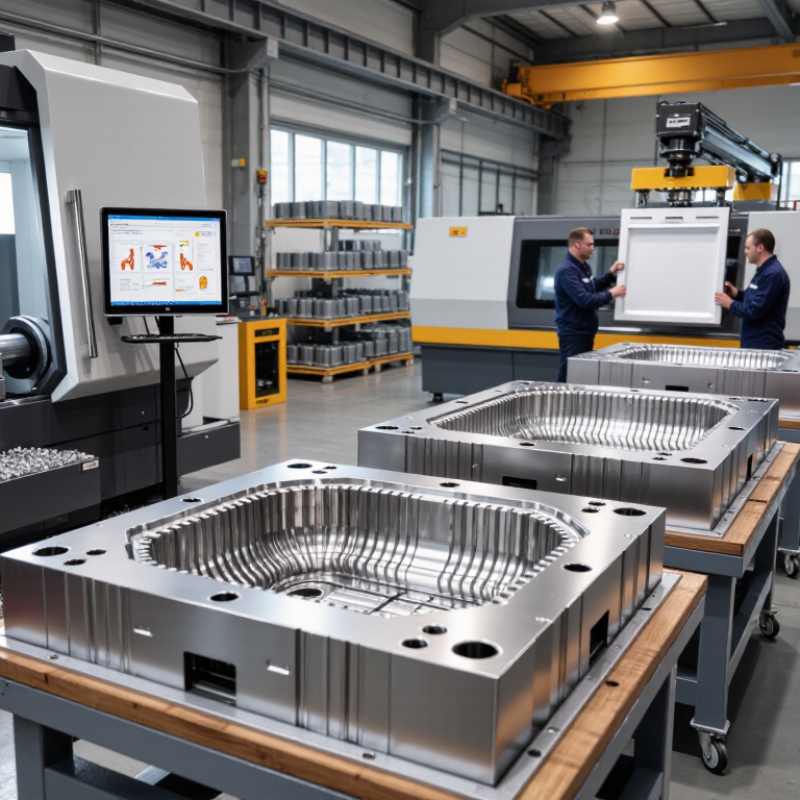
Dishwasher tooling covers the molds, dies, fixtures, and inspection equipment used to produce dishwasher components. Injection molds shape detergent cups, spray arms, control bezels, and plastic supports. Deep-drawing dies form stainless-steel tubs and inner doors. Thermoforming tools may produce insulation panels, while assembly fixtures hold parts during sealing, fastening, and leak testing.
Each tool has a different job. A tub-forming die must control wall thickness around corners and drain openings. An injection mold needs balanced filling, reliable cooling, and smooth ejection.
Small dimensional errors can cause door misalignment or water leakage. They matter. In practical production, I would check steel hardness, cavity polish, cooling-channel access, and replacement-part availability before approving a tooling supplier in China.
Manufacturing requirements should include clear drawings, material standards, tolerance limits, and sampling procedures. Corrosion-resistant mold steel is important because moisture and cleaning chemicals create harsh conditions. Toolmakers should verify critical dimensions with calibrated gauges and record trial results. Stable cycle times also reduce deformation and production waste. Yet perfect tooling does not guarantee perfect parts. Resin shrinkage, uneven cooling, and operator adjustments can still create defects. That risk deserves honest review, not optimistic paperwork. Regular maintenance, spare inserts, and documented corrective actions help keep tooling reliable during long production runs.
A “top ten” list is only a starting point. The best supplier depends on your dishwasher design, annual volume, resin, and delivery window. Request a detailed tooling proposal, not a single price. It should show steel grade, mold life, cooling layout, expected cycle time, and maintenance scope. Ask for recent tooling samples with similar size and complexity. Large dishwasher tubs need stable support, balanced filling, and reliable ejection. Small spray-arm molds demand different precision.
Visit the factory or arrange an independent audit. Check machining equipment, inspection records, mold assembly areas, and spare-part storage. Measure how engineers handle design changes. A capable team explains risks before production begins. Review dimensional reports, trial videos, and correction logs. Ask whether the supplier can provide mold-flow analysis and documented trial results. Quality certificates help, but they cannot replace physical evidence.
Use a weighted scorecard for all ten candidates. Include technical capability, communication speed, tooling cost, lead time, warranty terms, and after-sales response. Confirm material traceability and compliance with applicable safety requirements.
I once gave too much weight to a low quotation. The later correction work consumed more time than expected. That experience still matters.
A slightly higher price may be reasonable when it includes stronger steel, better cooling, and clearer engineering ownership. However, never accept vague promises. Put acceptance criteria, inspection methods, spare parts, and change-control procedures into the contract.
China’s top 10 dishwasher tooling suppliers are often separated by practical strengths, not impressive promises. One profile focuses on large injection molds for inner tubs and detergent trays. Another specializes in stainless-steel stamping dies, producing accurate door panels and brackets. A third combines mold flow analysis with rapid prototyping, reducing defects before steel cutting begins.
Several suppliers serve high-volume appliance programs with automated machining, CMM inspection, and controlled tool maintenance. One experienced workshop is known for complex sliding cores and tight sealing surfaces. Another provides die-casting tools for pumps, hinges, and structural parts. A smaller supplier may offer faster communication and flexible engineering changes, although its production capacity can be limited.
The remaining profiles include suppliers skilled in deep drawing, plastic overmolding, and multi-cavity tooling. Some provide complete tooling packages, including spare inserts, trial reports, and export packing. Others focus on repair work, which matters when a worn cavity stops production unexpectedly. In factory visits, clean assembly areas and traceable inspection records reveal more than polished brochures. Still, no supplier performs perfectly. Trial runs may expose warpage, uneven cooling, or difficult ejection. Experienced buyers should review steel grades, mold-life targets, sampling data, and after-sales response before choosing among China’s leading dishwasher tooling suppliers.
| Rank | Supplier Profile | Primary Dishwasher Tooling | Common Mold Materials | Core Manufacturing Capabilities | Typical Component Applications | Quality & Validation Focus | Export Orientation | Typical Project Lead Time |
|---|---|---|---|---|---|---|---|---|
| 1 | Supplier Profile A | Injection molds Large exterior molds | Pre-hardened mold steel; hardened tool steel for wear areas | High-speed CNC machining, EDM, CMM inspection, mold-flow analysis | Door panels, control bezels, detergent trays, outer housings | Dimensional inspection, sampling trials, functional fit testing, process documentation | Regularly supports overseas appliance programs through OEM and contract-manufacturing channels | Approximately 8–14 weeks, depending on size and complexity |
| 2 | Supplier Profile B | Thin-wall injection molds Multi-cavity molds | Hardened tool steel; corrosion-resistant steel for demanding applications | Multi-cavity balancing, hot-runner integration, automated mold-base production | Interior racks, spray-arm parts, clips, small functional plastic components | Gate-balance verification, cycle testing, cavity-to-cavity consistency checks | Experienced in international tooling transfers and remote design reviews | Approximately 7–12 weeks for standard production molds |
| 3 | Supplier Profile C | Overmolding tools Insert-molding tools | Pre-hardened steel with hardened inserts in high-wear zones | Insert positioning, two-material molding support, precision EDM and wire cutting | Handles, seals, electrical interfaces, soft-touch control components | Insert repeatability, bonding quality, leak-resistance checks, assembly trials | Suitable for appliance suppliers requiring engineering support across multiple regions | Approximately 9–15 weeks, including prototype validation |
| 4 | Supplier Profile D | Structural injection molds Reinforced-plastic molds | Pre-hardened tool steel; hardened steel for sliders and lifters | Large-format CNC machining, slider design, warpage analysis, trial optimization | Base frames, pump covers, support brackets, lower dishwasher structures | Warpage control, fit-and-function testing, repeated mold trials, change management | Commonly works with export-oriented appliance manufacturers and system integrators | Approximately 10–16 weeks for large or complex tooling |
| 5 | Supplier Profile E | Precision small-part molds Unscrewing molds | Hardened tool steel; stainless grades where moisture exposure is significant | Precision CNC, micro-EDM, threaded-core machining, high-accuracy polishing | Valves, knobs, latches, adjusters, water-path fittings | Thread and shut-off inspection, leakage testing, dimensional capability studies | Supports low- to medium-volume international programs and replacement tooling | Approximately 6–11 weeks for compact tooling |
| 6 | Supplier Profile F | Decorative-part molds Texture-ready molds | Pre-hardened mold steel with polished or textured cavity surfaces | Surface polishing, texture preparation, appearance-part trial molding, CNC engraving | Visible door trims, fascia panels, handles, decorative covers | Surface uniformity, gloss and texture comparison, color and appearance approval samples | Well suited to export products requiring consistent cosmetic standards | Approximately 8–13 weeks, including surface approval |
| 7 | Supplier Profile G | Compression molds Rubber and sealing molds | Hardened steel; stainless tool materials for wet or chemically exposed areas | Compression tooling, vent design, flash-control machining, temperature-uniformity review | Door gaskets, pump seals, vibration isolators, flexible protective parts | Compression-set evaluation, dimensional recovery, leak testing and aging checks | Provides tooling for appliance component makers serving domestic and export markets | Approximately 6–10 weeks for standard sealing tools |
| 8 | Supplier Profile H | Die-casting dies Metal forming tools | Hot-work die steel; hardened inserts for high-temperature wear areas | Die-sinking EDM, die machining, cooling-channel design, trimming-die integration | Hinges, brackets, motor supports, metal pump and door components | Porosity review, dimensional inspection, casting-trim validation, repeat-cycle testing | Suitable for industrial appliance supply chains with cross-border production | Approximately 10–18 weeks, depending on casting size and alloy |
| 9 | Supplier Profile I | Prototype tooling Bridge-production molds | Aluminum for short runs; pre-hardened steel for bridge production | Rapid CNC machining, soft tooling, additive design verification, quick-turn sampling | New-product housings, control panels, brackets, fit-check components | Design-for-manufacturing review, prototype dimensional reports, assembly verification | Useful for overseas product launches and engineering change verification | Approximately 2–6 weeks for prototype or low-volume tooling |
| 10 | Supplier Profile J | Family molds Appliance accessory molds | Pre-hardened mold steel; hardened steel for inserts and core components | Family-cavity layout, interchangeable inserts, CNC machining, EDM and mold repair | Cutlery baskets, clips, brackets, covers and auxiliary dishwasher accessories | Part-to-part consistency, cycle-time review, interchangeability and maintenance planning | Often supports multi-part appliance programs and tooling consolidation projects | Approximately 7–13 weeks, depending on cavity count and part range |
| Note: Supplier identities are intentionally omitted. Lead times are typical industry ranges for dishwasher tooling projects and may vary according to part size, material, cavity count, surface requirements, mold standard, validation scope and engineering changes. | ||||||||
China’s top ten dishwasher tooling suppliers typically compete through precision, speed, and process control. Their core services include stamping dies for stainless-steel tubs, injection molds for spray arms, and fixtures for door assemblies. Experienced suppliers use 3D CAD, flow simulation, and CNC machining to reduce warping and uneven wall thickness. Some also apply hot-runner systems for stable plastic filling and lower material waste.
Quality control happens at several stages. Engineers inspect steel hardness, cavity dimensions, and cooling channels before mold trials. Coordinate measuring machines can verify tolerances within a few microns. Trial production often includes leak testing, dishwasher-cycle testing, and dimensional reports. Reliable suppliers provide design reviews, mold-flow analysis, sample approval, and production support after delivery. They may also offer reverse engineering when an existing tool needs improvement.
Small details matter. A poorly placed ejector mark can remain visible on a control panel. An undersized cooling channel may extend cycle time by several seconds. No tooling plan is flawless. I have seen rushed tolerance decisions create expensive rework later. Suppliers should therefore document changes, protect revision data, and communicate realistic lead times. Useful services include spare inserts, preventive maintenance, repair training, and remote troubleshooting. Clear inspection records build trust, but practical factory experience still matters more than attractive specifications.
This benchmark compares the number of leading Chinese dishwasher tooling suppliers commonly offering each capability. CNC mold machining, multi-slide injection tooling, mold-flow analysis, and trial-run support are among the most widely available services, while automation integration and in-mold labeling are more specialized.
Choosing a Chinese dishwasher tooling supplier requires more than comparing quoted prices. Start by checking experience with large plastic parts, complex ribs, sealing surfaces, and heat-resistant materials. Ask for sample drawings, dimensional reports, and photographs of completed molds. Real evidence is more useful than polished promises.
Inspect the tooling plan carefully. Mold steel, cooling channels, ejection design, and surface treatment affect cycle time and product stability. Request steel certificates and a clear maintenance schedule. A dependable supplier should explain expected mold life, replacement parts, trial procedures, and tolerance control. Ask how they handle warping after injection. This problem is easy to underestimate.
Communication also matters. Confirm who approves design changes, how often progress updates arrive, and which files are shared. A factory visit can reveal housekeeping, machining capacity, inspection equipment, and storage conditions. Video inspections help, but they are not equal to physical checks.
Do not choose from a ranking alone. “Top ten” lists may change quickly. A lower-cost offer can become expensive after repeated corrections. Even experienced buyers miss small details, especially around cooling balance and assembly fit. Leave time for a second tooling review. That pause may prevent a costly lesson.
